Real Estate Market in Israël 2025-2026
Real estate market in Israël 2025-2026: prices and trends
Contents
After several years of strong growth, the Israeli real estate market is entering a new phase. In 2025, slower transaction activity, rising inventories of new homes and financing conditions shifted the balance of power between buyers and developers. In 2026, trends vary significantly by city, neighbourhood and property type.
For French and international buyers, this period calls for careful analysis: opportunities are no longer necessarily found where prices have risen most, but where location, development quality and purchase price offer the best balance.
1. A more selective market in 2025-2026
In 2025, Jérusalem recorded 5 638 home sales, ahead of Tel-Aviv with 5 159 transactions. Haïfa totalled 4 726 sales and Beer-Sheva 3 572. Despite this activity, the market experienced a marked slowdown, and the national inventory of unsold new homes reached a record level of approximately 86 000 units, according to Israeli official statistics reported by Globes in February 2026.
This situation has intensified competition among developers. Some offer flexible payment arrangements, favourable payment schedules or other sales incentives. These benefits can provide negotiating leverage, but they must be assessed against the actual price of the property, the contractual terms and any payment indexation.
In 2026, prices are not following a uniform trajectory. Data published by Ynet based on figures from the Israeli Central Bureau of Statistics show that the national average home price stood at approximately 2,392 million shekels in the first half of 2026, compared with 2,303 million in the first half of 2025, an increase of approximately 3,9 %. However, several major cities recorded a decline in their average price.
2. Property prices: comparing the main cities
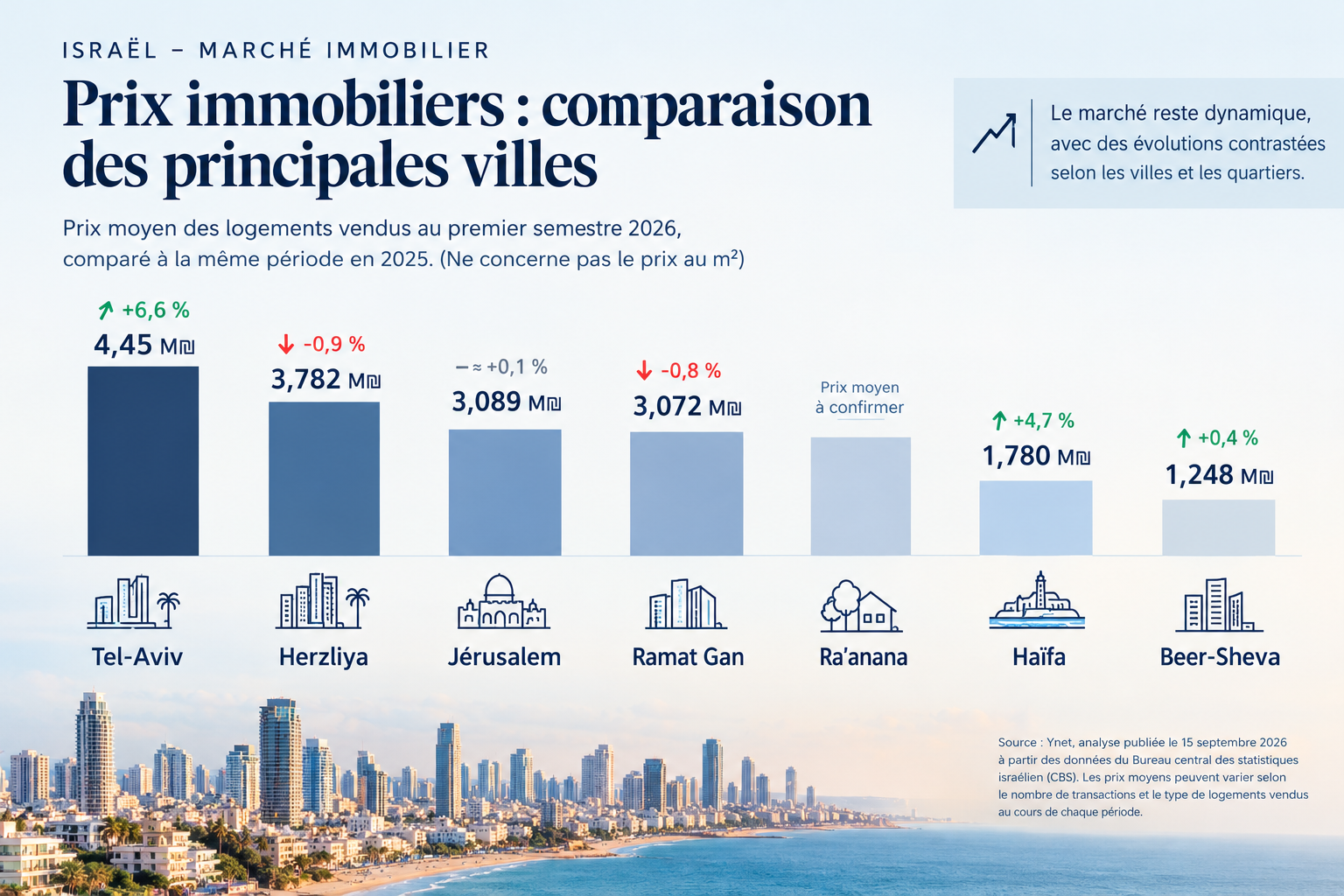
The following figures represent the average price of homes sold in the first half of 2026, compared with the same period in 2025. They cover both new and existing homes of all sizes and do not represent prices per square metre.
Tel-Aviv: 4,45 million shekels — up 6,6 % year on year. The city remains the most expensive residential market in this selection, with substantial differences depending on the neighbourhood and the quality of the properties.
Herzliya: 3,782 million shekels — down 0,9 %. The market benefits in particular from the appeal of its coastline, Herzliya Pituah and its proximity to business hubs in the centre of the country.
Jérusalem: 3,089 million shekels — virtually stable, with an increase of approximately 0,1 %. The capital has very different markets across its neighbourhoods, from the city centre and historic districts to residential areas.
Ramat Gan: 3,072 million shekels — down 0,8 %. Its proximity to Tel-Aviv, its business hubs and its urban renewal projects contribute to its appeal.
Ra’anana: average price to be confirmed using comparable official data. The city particularly attracts families seeking a residential environment and access to employment hubs in the centre of the country. When assessing a new development, it is preferable to compare recent transactions in the relevant neighbourhood.
Haïfa: 1,780 million shekels — up 4,7 %. The city offers a more accessible entry price than the main markets in the centre of the country, with significant differences depending on the neighbourhood and proximity to university, medical and business hubs.
Beer-Sheva: 1,248 million shekels — up 0,4 %. Its more accessible price level may appeal to investors, particularly around the university and major employment hubs, subject to a detailed analysis of rental demand.
Source: Ynet, analysis published on 15 September 2026 based on data from the Israeli Central Bureau of Statistics (CBS). Average prices may vary depending on the number of transactions and the types of homes sold during each period.
These figures provide a general benchmark. When comparing new developments, buyers should also consider the price per square metre, floor level, orientation, outdoor space, parking, payment terms and handover date.
Tel-Aviv: a premium market that remains dominant
With an average price of approximately 4,45 million shekels, Tel-Aviv remains the most expensive residential market among the cities studied. The first half of 2026 shows an increase of 6,6 % compared with the corresponding period in 2025. This growth should nevertheless be interpreted with caution: the mix of transactions, particularly sales of high-end properties in central neighbourhoods and the Old North, has a significant influence on the average.
For investors, neighbourhood selection, architectural quality, outdoor space, parking and prospects for capital appreciation are decisive factors.
Herzliya and Ramat Gan: alternatives in the centre of the country
Herzliya has an average price of approximately 3,78 million shekels, while Ramat Gan stands at around 3,07 million. Both cities recorded a slight year-on-year decline.
Herzliya remains a sought-after location thanks to its coastline, Herzliya Pituah and its business environment. Ramat Gan benefits from its proximity to Tel-Aviv, its business hubs and urban renewal initiatives. In both cases, a property's value depends heavily on its precise address and the characteristics of the development.
Jérusalem: structural demand and a diverse market
The average price stands at approximately 3,09 million shekels, virtually unchanged from the first half of 2025. The city retains distinctive fundamentals: its cultural and religious role, diverse residential demand and very different neighbourhood markets.
For overseas buyers, the choice between the city centre, historic districts, residential neighbourhoods and developing areas should reflect the intended use, budget and planned holding period.
Ra’anana: a residential market requiring neighbourhood-level analysis
Ra’anana particularly attracts families seeking a residential environment, schools and access to employment hubs in the centre of the country. However, data from Globes published in December 2025 indicated a marked slowdown in transactions in the first half of 2025 compared with previous periods.
As the average price for Ra’anana in the first half of 2026 is not established in the comparative table cited here, assigning it a precise figure without a consistent source would be misleading. To assess a new development, buyers should compare recent transactions involving homes of the same size, in the same area and with comparable specifications and amenities.
Haïfa: a more accessible entry price
With an average price of 1,78 million shekels, up 4,7 % year on year, Haïfa offers significantly lower prices than the centre of the country. Its appeal depends particularly on the neighbourhood, transport access, university and medical hubs, employment and proximity to the coastline.
This price difference may open up more accessible purchasing strategies, but it does not in itself guarantee better rental returns.
Beer-Sheva: a more budget-focused approach
The average price stands at approximately 1,25 million shekels in the first half of 2026, a slight year-on-year increase of 0,4 %. Beer-Sheva remains a less expensive alternative, with demand linked particularly to the university, medical activities and the regional employment market.
For a rental investment, proximity to sources of demand, ongoing costs, purchase price and realistically achievable rent must be assessed together.
3. Buying a new-build property: criteria to examine
The market slowdown may create attractive negotiating conditions, but an appealing sales offer alone does not guarantee a sound investment.
Before reserving a new-build apartment, it is essential to check:
The total price: contractual price, additional costs and any indexation.
The payment schedule: initial payment, instalments and balance due on handover.
The developer: track record, guarantees and actual project progress.
The neighbourhood: transport, services, schools, employment and development plans.
The rental potential: comparable rents, vacancy, ongoing costs and taxation.
The investment horizon: primary residence, pied-à-terre or long-term investment.
For overseas buyers, financing arrangements, applicable taxation and acquisition costs should also be reviewed with qualified professionals.
Conclusion: prioritise the quality of the purchase
The Israeli real estate market in 2025-2026 is not uniform. Tel-Aviv retains high prices, Herzliya and Ramat Gan offer distinct profiles, and Jérusalem remains a distinctive market, while Haïfa and Beer-Sheva offer more accessible entry prices. Ra’anana, meanwhile, should be assessed using precise local comparables.
The best opportunity is not necessarily in the city where prices are rising fastest, but in the development whose price, location, features and purchase terms genuinely align with your plans.
Guidance from a professional familiar with developers, neighbourhoods and recent transactions allows buyers to compare developments on a concrete basis and make an informed decision.
Sources and references
Ynet — Property prices in the first half of 2026: Analysis of prices by city, published on 15 September 2026.
Globes — Price trends between 2022 and 2025: Tel Aviv home prices fall as other cities gain ground, published on 3 December 2025.
Globes — 2025 sales review: Jerusalem overtakes Tel Aviv for homes sold, published on 12 February 2026.
Israeli Central Bureau of Statistics (CBS): Official website, institutional source for statistics on transactions, prices and unsold new homes.
This article is provided for general information only and does not constitute legal, tax or financial advice. Every situation is different — please consult a qualified professional before making any decision.
Planning a purchase in Israel?
Tell us about your plans — your GurInvest advisor will guide you with clarity and discretion.
Speak with an advisorFurther reading
New Developments
What is Tama 38?
Reinforcement, reconstruction, value enhancement: what you need to know before buying an apartment in a building involved in a Tama 38 project.
14 October 2026 · 3 min
New Developments
New-build developments in Israël: how they work and pitfalls to avoid
New-build developments in Israël: how they work and pitfalls to avoid Buying off-plan, payments, guarantees and choosing a developer: a guide to deciding between new-build and existing properties.
12 October 2026 · 4 min